Anonymity, Copyright and the Blockchain
If XCOPY's aesthetic is defined by the glitch, his philosophy is defined by a deliberate embrace of the paradoxes of digital ownership. In a medium preoccupied with doxxing and intellectual property, XCOPY has taken the opposite line, using anonymity and the surrender of copyright to reinforce rather than dilute the value of his work. He operates in the gap between two facts that should cancel each other out: the digital image is infinitely reproducible, and the blockchain makes it verifiably scarce.
The pseudonymous artist
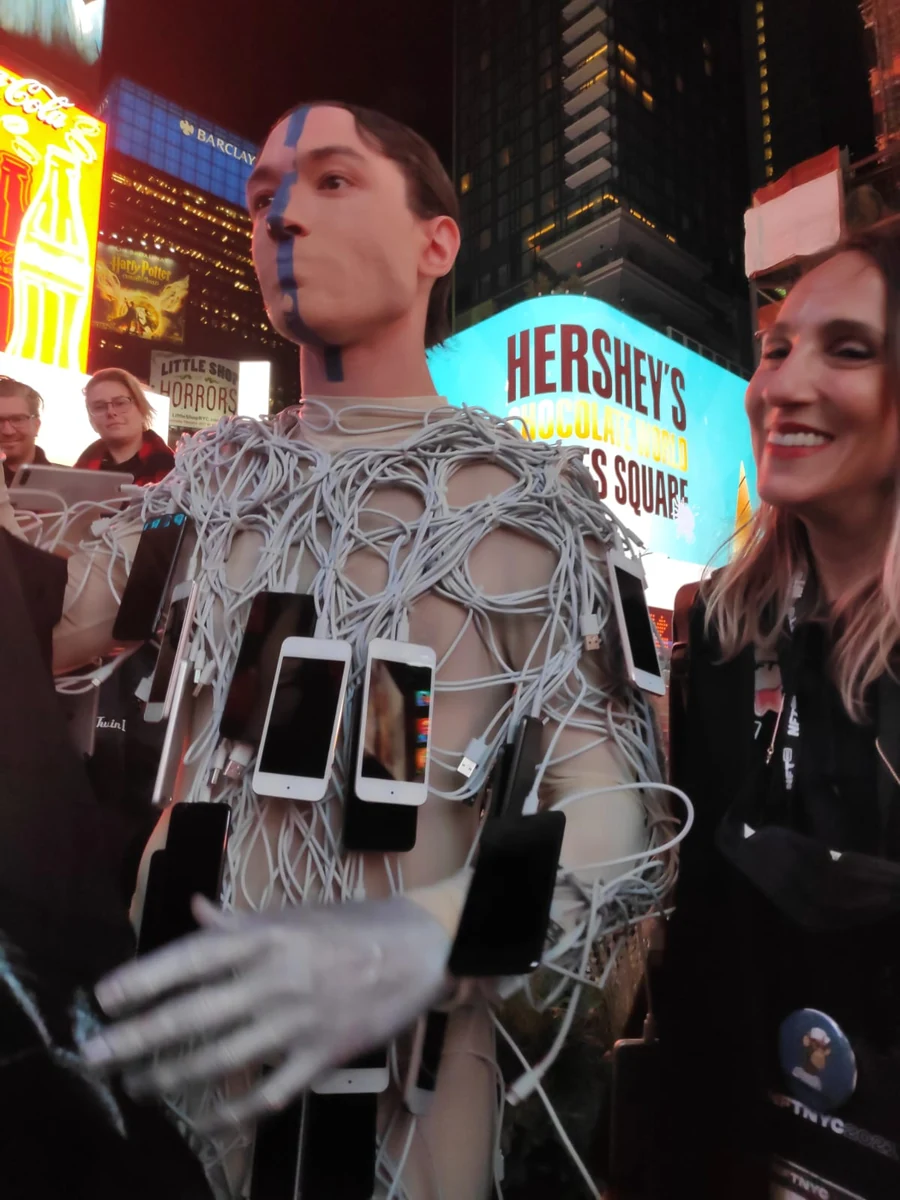
Despite being one of the highest-selling crypto artists of all time, XCOPY's identity remains unknown. It is public knowledge that he is male and based in London, confirmed during a meeting with the collector Kevin Rose, and that he has posted pseudonymously since his early Tumblr days in 2010. The anonymity is not simply a privacy preference. It is a working method. By removing the biography, XCOPY turns the persona into a puzzle and forces attention back onto the work. He operates as a native of the feed, and the stance aligns him with the cypherpunk roots of the blockchain, where contribution counts for more than identity.
The anonymity was never hermetic, and that is part of its texture. The early Tumblr leaked small fragments of a life. In one post from around 2012 he notes that he can see the Citibank tower from a window, which places him within sight of Canary Wharf. These are not confessions. They are crumbs, preserved by the archive but never resolving into a name. The feed gave up atmosphere, not identity.
Pseudonymity in digital culture
XCOPY is not the first artist to make anonymity part of the work, and the comparisons sharpen what he actually does.
Banksy is the analogue precedent. In his 2005 book Wall and Piece he wrote that copyright is for losers, and for years he let his images be copied freely. Yet since 2008 his authentication body, Pest Control, has decided which works count as real and has filed trademarks on his behalf. The contradiction is structural, not personal. Banksy cannot easily enforce copyright, because a copyright claim would require him to prove authorship, and proving authorship would require him to reveal his identity. The European Union Intellectual Property Office has repeatedly cancelled his trademarks, citing both his anonymity and his own anti-copyright statements. Banksy's authenticity therefore rests on a trusted human institution issuing certificates on letterhead. His anonymity and his ownership are permanently at war.

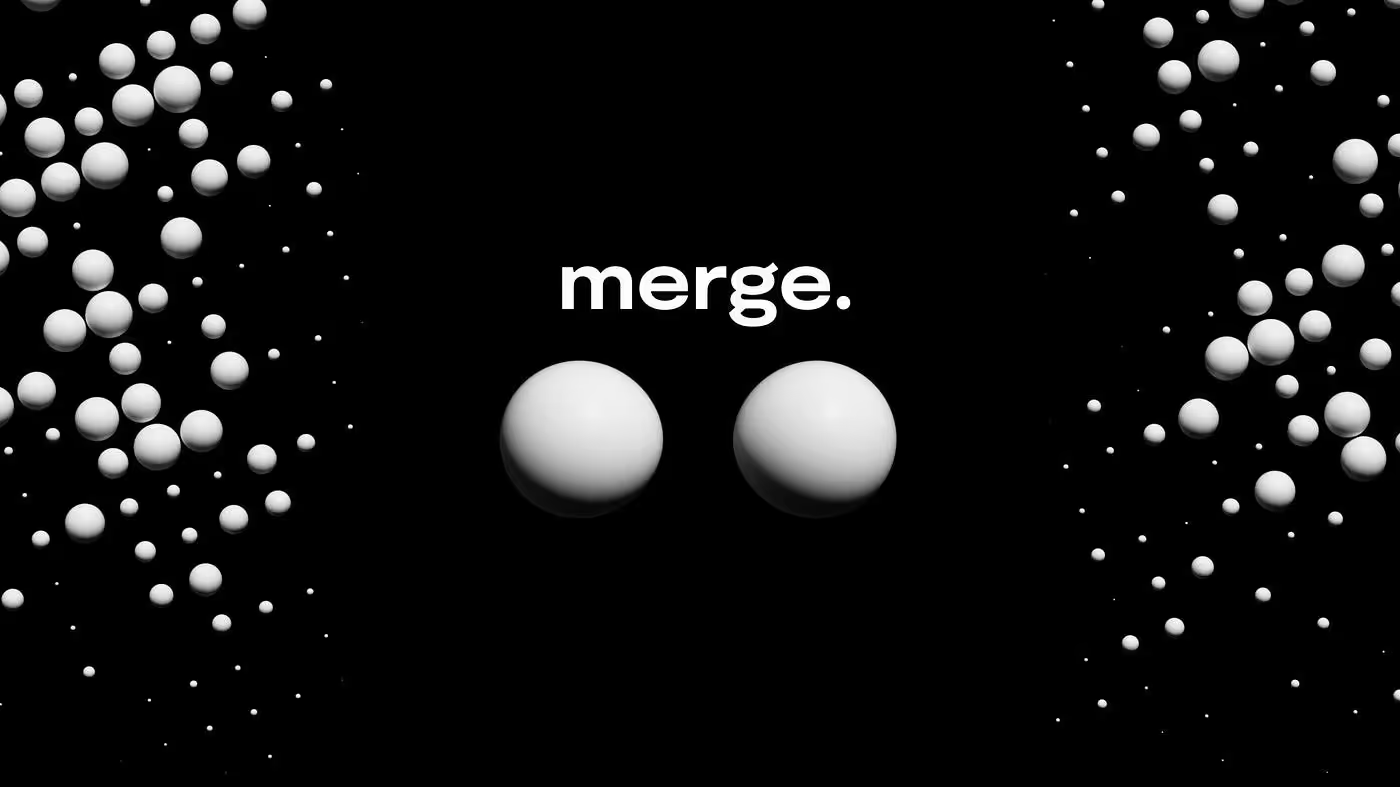
Pak is the native extreme. Pak's identity has never been established and may belong to more than one person. Rather than hide a self behind the work, Pak treats the machinery of ownership as the work, so that minting, burning and merging become the medium. The Merge, sold in December 2021, distributed more than 250,000 mass tokens to around 29,000 collectors and grossed 91.8 million dollars, and its entire content was a rule about how those tokens combined. For Pak the smart contract is the art, and anonymity is what lets the art stand free of any person or institution.
XCOPY sits between the two. He is as anonymous as Banksy and as native as Pak, but he escapes the trap that holds Banksy by a third route. He does not gatekeep authenticity through an institution, and he does not dissolve authorship into a protocol. He gives up copyright entirely and lets the blockchain, rather than a certificate, carry the proof.
Right-click and Save As Guy
His clearest statement on the friction between copyright and crypto is the 2018 work Right-click and Save As Guy. The piece is a direct satire of the most common charge against NFTs, that digital art is worthless because anyone can save the file. By making that charge the literal subject, XCOPY turns the sceptic's dismissal into the artefact itself.
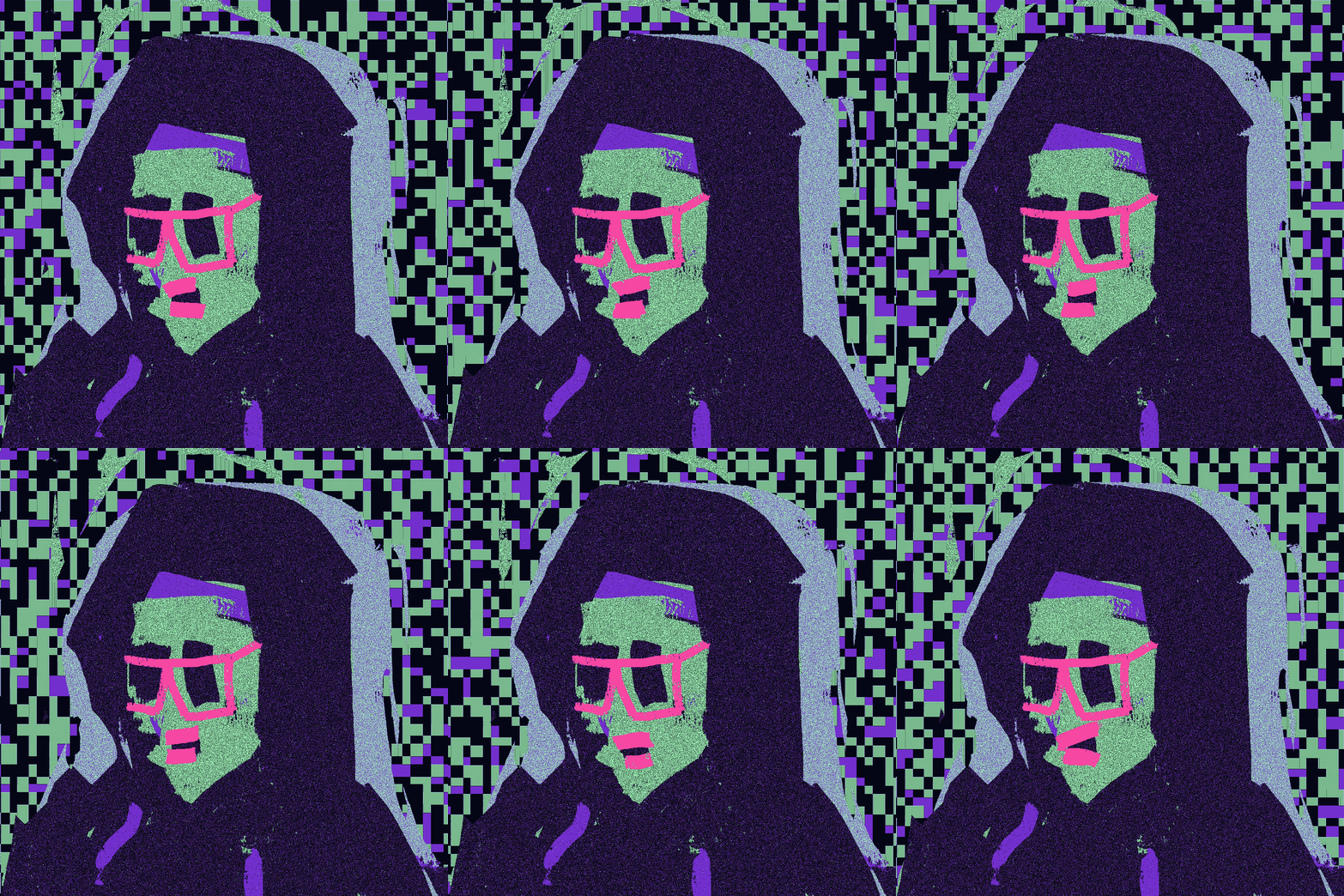
The work's history proves its own argument. The image has been right-clicked and saved countless times, and the token still sold to the pseudonymous collector Cozomo de' Medici for 1,600 ETH, roughly 7 million dollars, in December 2021. The value did not lie in restricting access to the picture. It lay in the provenance recorded on the chain. Anyone can hold the image. Only one address holds the work.
CC0 and the free-culture lineage
On 1 August 2022, XCOPY pushed this logic to its conclusion and placed all of his prior and future solo work under the Creative Commons Zero (CC0) licence (a16z crypto, 2025). CC0 relinquishes copyright altogether and dedicates the work to the public domain, so that anyone may remix, reproduce or sell his imagery without permission.
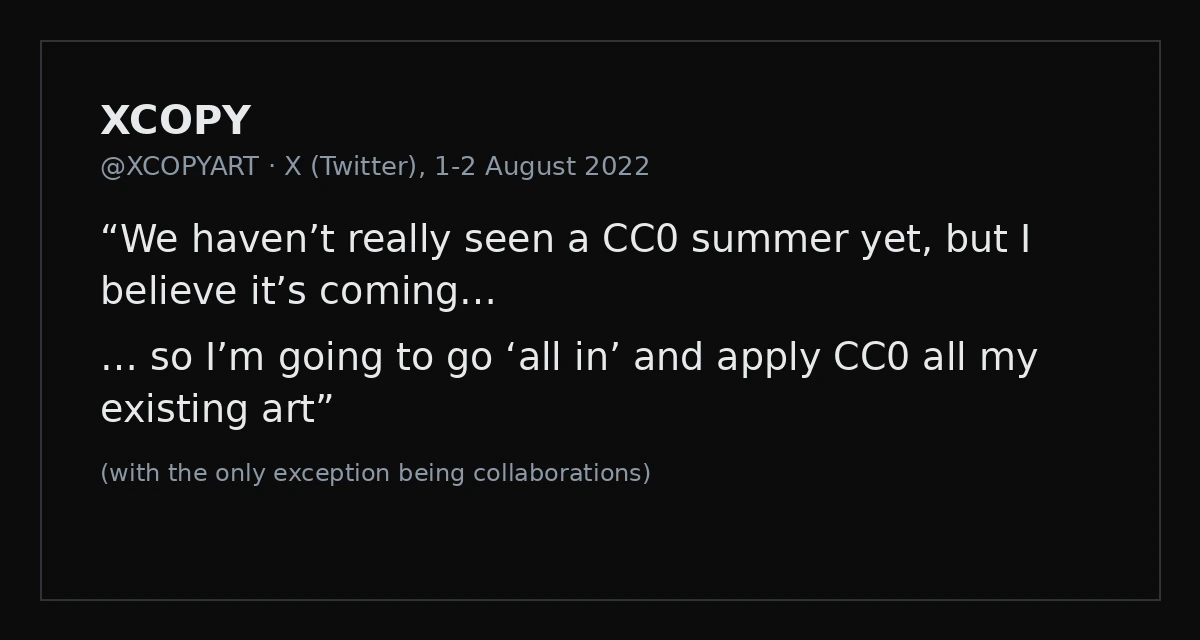
The bet is counter-intuitive. Traditional markets defend value with scarcity and copyright enforcement. XCOPY bet on the opposite force, cultural relevance. If the images spread freely as memes and derivatives, the cultural weight of the originals grows, and that weight accrues to the tokens whose provenance is fixed. He framed CC0 as a defence against the moment a subculture turns sociopathic, when opportunists try to gatekeep and monetise symbols the community made. Creative works, as he put it, live and die by their cultural relevance, and CC0 removes the friction that relevance needs in order to spread.
The gesture has a lineage. The Creative Commons licences were not built by artists but by free-culture activists, and their emblem is Aaron Swartz. As a teenager Swartz helped write the RSS specification and contributed to the technical architecture of Creative Commons, and in 2008 he wrote the Guerilla Open Access Manifesto, which opens with the claim that information is power and argues that locking up the world's knowledge is a form of theft. He was prosecuted for downloading academic papers from JSTOR through the MIT network, faced decades in prison, and died in 2013, after which the open-access movement claimed him as a martyr.
XCOPY's CC0 move is that ethic carried into art, with one inversion. Swartz broke the law to free knowledge that others had locked away. XCOPY used a legal instrument built by Swartz's own movement to give away work that was his to keep. And he added the piece the free-culture argument never had to supply, because it was never selling anything. By pairing CC0 with the blockchain, XCOPY freed the image and fixed the ownership at the same time. The old objection, that a thing which is free cannot be valuable, is answered by splitting the file from the title. The picture is free. The provenance is not.
The blockchain as preservation
XCOPY's faith in the chain was earned the hard way. Early in his career he minted on platforms such as Ascribe and Rare Art Labs, both of which later shut down, taking metadata and access to the work with them because the images sat on centralised servers rather than a decentralised file system. Those failures drilled in the maxim: not your keys, not your crypto.
The response was a philosophy of preservation, and it has hardened over time. Early on he advocated storing images on IPFS rather than company servers, so that a marketplace going bankrupt could not erase the art. His recent work removes the external dependency altogether. Fresh Hell, first launched in 2023, is built on Manifold smart contracts with the works stored fully on-chain. Cope Salada, in 2024, writes its vector data directly into the smart contract, so the image survives as long as Ethereum does. His Art Blocks debut the same year, ICXN, is generative: the code that draws each of its 500 works is stored on-chain, so the artwork regenerates from the blockchain rather than from a hosted file. The direction is deliberate, and each of these binds the work more tightly to the ledger and further from anything that can rot. For XCOPY the blockchain is not only a sales ledger. It is a way to carry the history of digital art past the ordinary decay of the internet.
Marka created an interactive sequential viewer that cycles through all 500 ICXN outputs at 15-second intervals: https://icxn.netlify.app/?sequential=true&time=15. Credit: Marka (@marka_eth), https://x.com/marka_eth.
XCOPY has named the frame for this himself, on Tumblr, in a single photograph. It shows his own copy of Ubik, Philip K. Dick's 1969 novel, the cover dominated by an aerosol can, captioned only "they don't make them like this anymore." Ubik is a book about entropy. Its characters are held in half-life, a preserved state between death and rebirth that is quietly running down, and the world around them regresses as it decays, objects reverting to older and obsolete forms until they crumble to nothing. The one thing that halts the decay is Ubik itself, a substance sold, absurdly, from a spray can: salvation as a consumer product, applied against a universe sliding toward heat death. Read beside that novel, XCOPY's blockchain is his Ubik. Link rot, dead marketplaces and lost metadata are the entropy. IPFS and the on-chain file are the spray. Even the caption is part of the argument, because a line about durable things the present no longer makes is the exact loss his practice is built to refuse.

Which returns the chapter to its paradox, and resolves it. Anonymity, the surrender of copyright and the permanence of the chain look like three separate positions, but they are one. The person is hidden so the work can speak. The copyright is released so the work can spread. The ledger is fixed so the work can last, and so ownership can survive the copying. XCOPY gives away everything that can be copied and keeps the one thing that cannot.
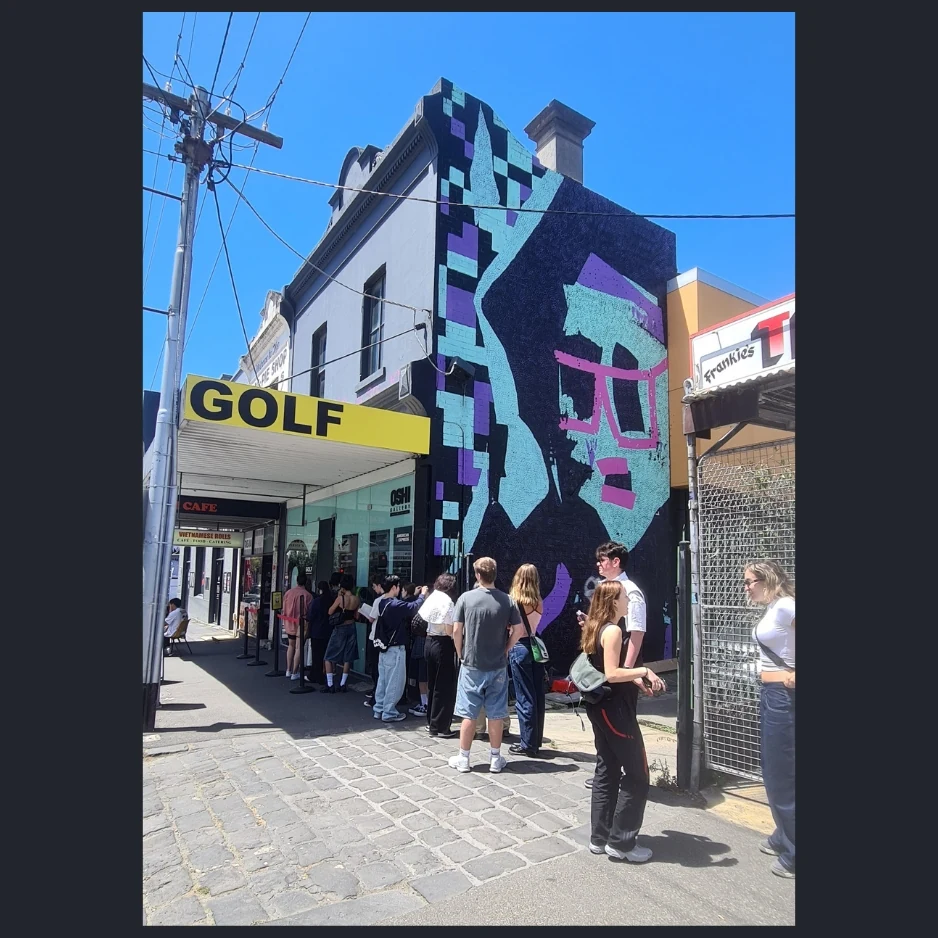
Mural adaptation of XCOPY’s No Favour, an example of the work’s circulation beyond its original tokenised form.